






Sustainability reporting and assurance requirements have become more regulated over the past year. This will have a corresponding impact on the South African business environment.
New standards have been adopted, timelines set, and guidance is available. We will provide you with a clear overview of the recent changes, outline the new assurance requirements, and detail the key steps organisations should consider to remain compliant and competitive.
- King V
King V replaced King IV and reduced the number of principles from 17 to 13. It was issued on 31 October 2025 and is effective for financial years beginning on or after 1 January 2026. Companies with December year-ends are already implementing the new requirements.
Three points to know:
- Four documents. King V contains Foundational Concepts, the Code, a Glossary and a new Disclosure Framework. The Disclosure Framework provides a standard way to report how a company implements the Code.
- Double materiality. King V endorses double materiality, encouraging organisations to consider both how sustainability issues affect the business and how the business impacts the broader economy, society, and environment.
- Integration with JSE requirements. The simplified JSE Listings Requirements took effect on 13 January 2026 for new listings and 16 February 2026 for existing listed companies. All Main Board companies must comply with King V, and the JSE has formally endorsed the King V Disclosure Framework.
- South Africa: voluntary today, mandatory on the way
No new sustainability reporting requirements are mandatory in South Africa at the moment; however, the direction is clearly toward mandatory reporting. From voluntary to mandatory, here’s where we are.
- JSE guidance (voluntary). In June 2022, the JSE published two voluntary guides: one on sustainability disclosure and another on climate change disclosure. The climate change guide is intended for all JSE-listed companies, scaled to their size and climate exposure. It draws on TCFD recommendations and the draft IFRS S2 for governance, strategy, risk management, and metrics and targets, while incorporating a South African perspective on the just transition and carbon tax. The JSE has reviewed both guides and determined that updates are premature given ongoing regulatory developments.
- King V (apply and explain). In principle voluntary, but required for JSE Main Board companies.
- Financial regulators (in the process). The FSCA is working with the IFC on disclosure rules in line with the ISSB standards (IFRS S1 and S2).
- CIPC working group (roadmap). In August 2026, the CIPC established a national working group to formulate a roadmap for adopting IFRS S1 and S2. That roadmap will form the basis for future legislation through the dtic.
- Carbon tax and GHG reporting (mandatory). Both apply above the relevant thresholds. The carbon tax rate is R308/tonne in 2026.
- The rest of Africa is moving faster
While SA is still working on its roadmap, several other African countries have already adopted the ISSB standards.
| Reporting starts | Countries |
| 2025 | Tanzania, Rwanda, Zambia |
| 2027 | Ghana, Kenya |
| 2028 | Nigeria, Uganda |
| Consulting or roadmap | Ethiopia, South Africa |
Notably, Ghana and Zambia have also adopted ISSA 5000, the new global sustainability assurance standard. Multinational groups operating across Africa may therefore encounter these requirements in subsidiaries before they become mandatory for the South African parent entity.
Source: IFRS Foundation jurisdictional profiles, as summarised by IAS Plus (March 2026). Start dates often apply to public interest entities first.
- Rules abroad already reach South African companies
Four regimes outside of South Africa have an effect on local groups (either directly or via their customers).
| Region | What changed | Who in South Africa is affected | From when |
| European Union | The Omnibus I directive narrowed the CSRD, but did not remove it | Large groups with significant EU operations; exporters of steel, aluminium, cement and fertiliser under CBAM | CBAM: now. Large groups: financial years from 2028 |
| United Kingdom | The UK published its own versions of the ISSB standards | Companies listed in London, on a comply-or-explain basis | Periods from 1 January 2027 |
| United States | The federal SEC climate rule has stalled, but California is moving | US subsidiaries doing business in California with revenue over $1 billion | First emissions reports due November 2026 |
| Australia | Climate reporting is mandatory and phasing in | Australian subsidiaries above the thresholds | Phasing in to July 2027 |
The common thread across these jurisdictions is reliable emissions data that can be verified, which underlines the importance of assurance processes.
- New standards: climate settles, nature is next
Climate reporting rules are settling from 2027, and nature is next.
- Climate. GRI’s updated climate change and energy standards (GRI 102 and 103), together with the ISSB’s targeted amendments to IFRS S2 (issued December 2025), will apply to reporting periods starting on or after 1 January 2027.
- Convergence. The UK published its versions of IFRS S1 and S2 in February 2026. The EU adopted its simplified ESRS in July 2026 (with over 60% fewer mandatory data points), applying to financial years from 2027.
- Sector-specific standards. The GRI has approved new sector standards for banks, insurers, and capital markets, scheduled to launch in 2027.
- Nature. On 22 October 2026, the ISSB published proposals on nature-related disclosures as a Practice Statement (to sit alongside IFRS S1 and S2). Comments close on 19 February 2027.
- ISSA 5000: the new assurance standard is weeks away
ISSA 5000 is the new global standard for assurance on sustainability information. The IRBA adopted it for South Africa in February 2026, together with the new ethics and independence rules for sustainability assurance (Part 5 of the IRBA Code).
What to remember:
- One standard for any sustainability topic and any reporting framework, at the level of limited or reasonable assurance.
- Effective date. ISSA 5000 becomes effective on 15 December 2026 and applies to engagements for periods starting on or after that date, or to information as at a specific date on or after that date. Early adoption is permitted.
- ISAE 3410 withdrawn. ISAE 3410 is withdrawn on the same date. Until then, the interim rules are ISAE 3000 read with SAAEPS 1, with ISAE 3410 still available for greenhouse gas statements.
- Reasonable assurance by registered auditors only. In South Africa, only registered auditors may provide reasonable assurance over sustainability information. Other practitioners may still sign limited assurance reports (IRBA Staff Practice Alert 12, FAQs 1.5 and 1.6).
- It’s global. The UK, Australia, Ghana and Zambia have all adopted it as well.
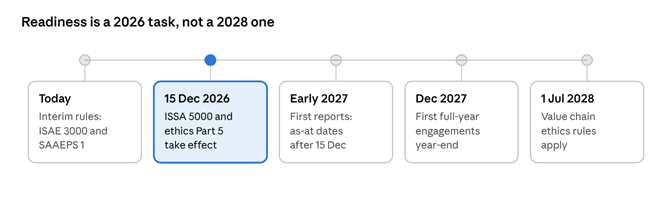
ISSA 5000 key dates
For companies with a December year-end, the first full year subject to ISSA 5000 ends in December 2027. However, engagements on information as at a specific date after 15 December 2026 could start as early as the beginning of 2027.
- Our sustainability services
Moore South Africa already offers a full range of sustainability services:
| Area | Services |
| Deals and finance | Financial due diligence and valuations · Financial modelling and structuring |
| Strategy and impact | Climate and sustainability planning · Impact and reporting |
| Reporting and assurance | Pre-assurance readiness · Sustainability reporting · Sustainability assurance |
- Six next steps
- Check your exposure. Do King V, the JSE or a rule overseas (EU, UK, US, Australia or CBAM) impact your business or your customers?
- Know your first assurance date. Work out when your first ISSA 5000 engagement could fall (a period commencing after 15 December 2026 or an earlier as-at date).
- Get your data ready. Start with the emissions data and the controls around that. A readiness review prior to assurance will save you time and avoid surprises.
- Check independence. If one firm is assisting you with the preparation of your sustainability information, then a separate firm may be required to verify it.
- Build the skills. Make sure your board, finance and sustainability teams are all up to speed with the new rules.
- Watch the roadmap. Follow the CIPC working group’s draft roadmap and consider commenting on the ISSB’s nature proposals prior to 19 February 2027.
The rules are in plain sight
King V is in force. South Africa’s roadmap is being drafted, and the rest of Africa is ahead of us. Rules abroad are already applicable to local companies. The new assurance standard takes effect on 15 December 2026.
None of that is hidden any more. The next stage is up to you.
To discuss what this means for your business, contact Leonie du Raan at [email protected].
Sources
JSE – Sustainability and Climate Change Disclosure Guidance
IRBA – Staff Practice Alert 12: FAQs on sustainability assurance engagements (March 2026)
IRBA – Final pronouncement on ethics standards for sustainability assurance
CIPC – National Adoption Readiness Working Group on sustainability reporting
IAS Plus – Adoption of IFRS Sustainability Disclosure Standards by jurisdiction (March 2026)
Covington – EU Omnibus I published in the Official Journal
FCA – PS26/19: Aligning listed issuers’ sustainability disclosures with international standards
Sullivan & Cromwell – CARB initial regulation under SB 253 and SB 261
BDO Australia – Path to assurance over sustainability reporting
IFRS Foundation – Amendments to IFRS S2 greenhouse gas emissions disclosures